Issue No. 01 — THE DRIVE ISSUEFeatures · Story 3 of 3
Bugatti Type 35 · 1924
ICONS · THE ART OF SPEEDWHEN DRIVING BECAME A SPORT
By the 1920s, the automobile had already transformed transportation. But on the dangerous roads and racing circuits of Europe, something extraordinary was happening. Cars were becoming objects of competition, beauty and obsession. With its unmistakable blue bodywork, elegant proportions and extraordinary racing record, the Bugatti Type 35 became one of the defining machines of this new era—when speed became spectacle and the racing driver became a hero.
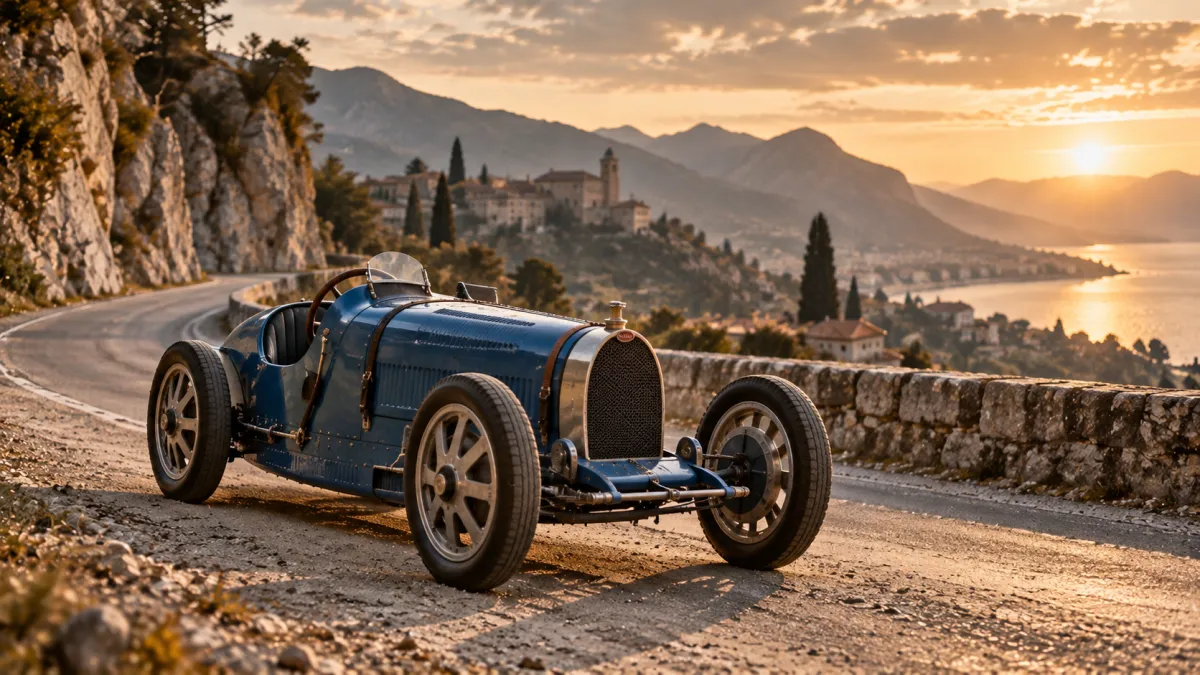
How the Bugatti Type 35 transformed racing success into something far greater: beauty, celebrity, mythology and an enduring obsession with speed.
Bugatti Type 35 · 1924 There was a time when the automobile was simply an extraordinary invention. Then it became transportation. Then something happened. People started racing. Not because they needed to arrive somewhere. Not because the journey was particularly important. And certainly not because driving as fast as possible on narrow, unforgiving roads was sensible. They raced because they wanted to be faster than somebody else. Because machines could be improved. Because engineers wanted to prove themselves. Because drivers wanted to win. And because the spectacle of speed had become impossible to ignore. By the 1920s, Europe was experiencing a remarkable transformation. The automobile was no longer merely a mechanical curiosity or a practical solution to transportation. It was becoming entertainment. Competition. Status. Art. And, increasingly, an obsession. At the center of this world stood one of the most beautiful racing machines ever created. The Bugatti Type 35.
THE WORLD DISCOVERS SPEED
The history of automobile racing began long before the Type 35. Almost as soon as motor vehicles became practical, people started comparing them. Which was faster? Which was more reliable? Which manufacturer had built the better machine? Early competitions, including the Paris–Rouen event of 1894 and the Paris–Bordeaux–Paris race of 1895, demonstrated how quickly the automobile had become something more than transportation. Racing offered manufacturers an opportunity to prove their engineering. It offered wealthy enthusiasts an extraordinary new pastime. And it offered spectators something they had never experienced before. Machines traveling at speeds that seemed almost impossible. By the early 20th century, major races were attracting enormous attention. The Gordon Bennett Cup. The French Grand Prix. The Targa Florio. Indianapolis. Motorsport was developing its own traditions, heroes and rivalries. The automobile had created a new form of sporting competition. And unlike many traditional sports, the athlete and the machine were inseparable. A racing driver needed courage. But courage alone wasn’t enough. Victory depended on engineering, preparation, mechanical reliability and an intimate understanding of the car. That relationship would eventually become one of the foundations of automotive enthusiasm.
EUROPE IN THE ROARING TWENTIES
To understand the Bugatti Type 35, we have to understand the world into which it arrived. The First World War had ended only a few years earlier. Europe was rebuilding. Technology was advancing rapidly. Aviation captured the public imagination. Cinema was becoming an increasingly important form of entertainment. Art, architecture and fashion were moving toward new forms of modernity. In certain circles, the 1920s became associated with glamour, experimentation and a fascination with progress. The automobile fit perfectly into this changing world. It represented modern technology in a form that people could see, hear and experience. For the wealthy, an automobile could express sophistication and independence. For engineers, it represented a challenge. For racing drivers, it offered fame. And for spectators, it provided a dramatic public spectacle. Motor racing was not simply a competition between machines. It was becoming part of modern culture.
THE MAN FROM MOLSHEIM
Ettore Bugatti was not an ordinary automobile manufacturer. Born in Milan in 1881, he came from a family deeply connected to art and design. His father, Carlo Bugatti, was an accomplished furniture and interior designer. His brother, Rembrandt Bugatti, became a sculptor celebrated for his animal figures. Ettore’s own medium would be mechanical. He established his automobile company in Molsheim in 1909, in the region of Alsace, which was then part of the German Empire and became French again after the First World War. From the beginning, Bugatti approached automobiles with an unusual combination of engineering ambition and aesthetic sensitivity. For Ettore, a racing car didn’t need to be beautiful merely as decoration. Its beauty could emerge from the precision of its design. Its proportions. Its materials. Its mechanical arrangement. The relationship between form and function. This philosophy would eventually produce one of the most recognizable racing cars in history.
1924: A NEW KIND OF RACING CAR
On August 3, 1924, the Bugatti Type 35 made its competition debut at the French Grand Prix near Lyon. Five examples entered the race, while another was held in reserve. The event was enormous. The circuit measured more than 23 kilometres per lap, and the race covered approximately 800 kilometres. This was a world far removed from modern motorsport. The circuit used public roads. The surfaces were imperfect. The cars were exposed. Mechanical problems could end a race instantly. And drivers faced risks that would be unacceptable in modern competition. The Type 35 arrived with a narrow, elegant body, a straight-eight engine and distinctive lightweight wheels. It looked different. More refined. More cohesive. Almost delicate compared with some of its contemporaries. But beneath that elegance was a machine designed for competition. Its first appearance was not a triumph. Tyre problems undermined Bugatti’s challenge. Yet the car’s potential was obvious. What began as a difficult debut would develop into one of the most successful competition careers in automotive history.
BEAUTY AT 200 KM/H
Look closely at a Bugatti Type 35. Even a century later, it is immediately recognizable. The horseshoe-shaped radiator. The long, narrow bonnet. The exposed wheels. The low, compact cockpit. The beautifully tapered rear bodywork. Nothing appears excessive. There are no unnecessary wings. No aggressive decorative openings. No theatrical styling devices. The entire machine looks purposeful. And that is what makes it extraordinary. The Type 35 demonstrates that a racing car can become visually iconic without sacrificing the clarity of its function. Its distinctive eight-spoke cast-alloy wheels are particularly important. They were lightweight, technically innovative and visually unforgettable. The wheels became part of the car’s identity. Today, automotive designers spend enormous amounts of time creating recognizable signatures. Lighting shapes. Grilles. Silhouettes. Wheel designs. The Type 35 achieved that kind of visual identity almost a century ago. Its engineering became its aesthetic.
THE COLOR OF A NATION
The Type 35 is almost impossible to imagine without blue paint. French racing blue. Before sponsorship liveries transformed motorsport, racing colors helped identify national representation. French cars were traditionally associated with blue. British cars with green. Italian cars with red. German cars with white, and later frequently silver. These colors became part of motorsport’s visual language. They connected machinery with national pride. A blue Bugatti wasn’t simply a beautiful object. It was a recognizable representative of French racing tradition. That identity survived long after the original racing regulations and conventions disappeared. Today, French racing blue remains one of the most evocative colors in automotive history. And few cars embody it more completely than the Type 35.
WHEN THE DRIVER BECAME A HERO
The automobile introduced a new kind of sporting celebrity. The racing driver. Unlike athletes competing with relatively simple equipment, racing drivers depended on machines that were themselves objects of fascination. A great driver could make a car famous. A great car could make a driver legendary. The relationship was mutually reinforcing. In the 1920s, motorsport’s leading figures became symbols of courage, skill and modernity. Their names appeared in newspapers. Their victories attracted attention far beyond the racing paddock. Their personalities became part of the story. The Bugatti Type 35 became associated with some of the era’s most celebrated drivers. Louis Chiron. Tazio Nuvolari. Alberto Divo. Bartolomeo Costantini. William Grover-Williams. These were not merely people operating machinery. They were the protagonists of a new kind of public drama. And the Type 35 became one of its most recognizable supporting characters.
THE WOMEN WHO RACED BUGATTI
The story of the Type 35 also challenges the assumption that early motorsport was exclusively a male pursuit. Among the remarkable drivers associated with the car were Hellé Nice and Eliška Junková. Junková, a Czech racing driver, became one of the most accomplished competitors of her era. Her performance in the 1928 Targa Florio was extraordinary. Driving a Bugatti Type 35B against leading international competitors, she challenged for victory before mechanical trouble contributed to a fifth-place finish. In a period when women faced substantial social barriers in competitive sport, her achievement demonstrated remarkable ability and determination. Hellé Nice, meanwhile, became known not only for her racing but also for her glamorous public persona. Her career connected motorsport with the wider worlds of celebrity, performance and modern femininity. These stories are essential to understanding the culture around the Type 35. Motorsport wasn’t simply developing new machines. It was producing new public figures and challenging established expectations about who could participate.
THE TARGA FLORIO
If one competition captures the extraordinary reputation of the Type 35, it is the Targa Florio. Held on the roads of Sicily, the race was among the most demanding events in international motorsport. Its routes passed through mountainous landscapes, villages and twisting public roads. Drivers faced uneven surfaces, unpredictable conditions and relentless physical demands. The Targa Florio required far more than outright speed. It demanded endurance. Mechanical sympathy. Concentration. And courage. Between 1925 and 1929, Bugatti Type 35 variants won the event five consecutive times. That achievement helped establish the car’s reputation for extraordinary effectiveness. But the cultural importance of the Targa Florio extends beyond the results. It connected motorsport with landscape. The roads themselves became part of the spectacle. Villages became viewing locations. Mountains became racing arenas. The event transformed ordinary geography into automotive mythology. That tradition survives today in the fascination enthusiasts have with particular roads. The Nürburgring. The Stelvio Pass. The Col de Turini. The mountain roads of Sicily. Some places become important not because of where they lead, but because of what happened there.
THE FIRST MONACO GRAND PRIX
In 1929, Monaco hosted its first Grand Prix. The race took place on streets winding through the principality. A setting that combined wealth, architecture, glamour and danger. A racing circuit unlike almost anything else. The winner was William Grover-Williams. His car was a Bugatti Type 35B. That victory became part of one of motorsport’s most enduring traditions. Today, the Monaco Grand Prix is associated with Formula One, celebrity yachts, luxury hotels and extraordinary wealth. But its roots reach back to an era when drivers raced exposed machines through narrow streets without modern barriers or sophisticated safety equipment. The Type 35 was present at the beginning. It helped connect the image of Bugatti with one of the world’s most glamorous sporting locations. And that connection between motorsport, luxury and spectacle would become central to the culture of high-performance automobiles.
RACING WAS THE ADVERTISEMENT
Long before social media, television commercials or influencer campaigns, racing was one of the most powerful ways for an automobile manufacturer to build a reputation. Victory demonstrated capability. A successful racing car suggested engineering excellence. A famous driver created public recognition. A distinctive machine made the brand memorable. Bugatti understood the value of this relationship. The Type 35 competed in Grand Prix races, road races, hill climbs and other events. Its repeated victories helped turn Bugatti into a name associated with technical sophistication and performance. The strategy would become familiar across automotive history. Ferrari built its identity around racing. Porsche developed a reputation through competition. Mercedes-Benz, Alfa Romeo, BMW, Audi and countless others used motorsport to establish credibility. Race on Sunday. Build reputation on Monday. The Type 35 stands among the clearest early examples of how competition could create a brand’s mythology.
THE PRIVATEER
Another important part of the Type 35 story is that its racing career extended beyond a single factory team. Bugatti built competition cars that could be purchased and raced by private owners. This helped create a broader community of Bugatti competitors. Racing was still expensive and far from accessible to ordinary people. But the Type 35 contributed to a sporting environment in which wealthy enthusiasts could become participants rather than merely spectators. Owners could enter events. Develop mechanical expertise. Build relationships with other drivers. Become part of a racing community. That distinction matters. Car culture isn’t created only by manufacturers. It is created by the people who use their machines. The Type 35 became a meeting point between engineering, ambition and personal enthusiasm.
MORE THAN A MACHINE
The Type 35’s remarkable competition record made it famous. But its design helped make it unforgettable. Many successful racing cars disappear from public memory. They become statistics. Names in record books. Photographs in archives. The Type 35 achieved something different. Its shape remained culturally recognizable long after its competitive career ended. That is the difference between a successful machine and an icon. A successful racing car wins. An iconic racing car becomes a symbol. The Type 35 became a symbol of an entire era. The dangerous romance of early Grand Prix racing. The glamour of European motorsport. The artistry of mechanical engineering. The courage of the racing driver. And the idea that speed could be beautiful.
THE BEGINNING OF AUTOMOTIVE DESIRE
The Ford Model T helped make the automobile accessible. The Bugatti Type 35 represented something fundamentally different. It was not designed to make everyday transportation easier. It was designed to compete. To perform. To win. And in doing so, it demonstrated that an automobile could be valuable for reasons unrelated to practical necessity. That idea would become one of the most important forces in automotive culture. Why buy a sports car when an ordinary car can reach the same destination? Why own a machine that is uncomfortable, expensive and difficult to maintain? Why care about horsepower? Handling? Engine sound? Steering feel? Because the automobile had become more than transportation. It had become an experience. The Type 35 helped establish the emotional vocabulary that enthusiasts still use today. Speed. Precision. Balance. Character. Beauty. Victory.
WHEN ENGINEERING BECOMES ART
The Type 35 also represents a particularly compelling idea. That engineering and art are not necessarily separate disciplines. Ettore Bugatti came from a family of artists. His racing cars reflected a sensitivity to form that distinguished them from many purely functional machines. But the Type 35 wasn’t beautiful because someone decorated it. Its beauty emerged from its engineering. The proportions of the body. The placement of the engine. The design of the wheels. The relationship between mechanical components. The elegance of the overall shape. This philosophy would influence the way enthusiasts think about automobiles. Some cars are admired because they are fast. Others because they are beautiful. The most memorable combine both. The Type 35 was among the earliest machines to demonstrate how powerful that combination could be.
A LEGACY WRITTEN IN BLUE
A century after its introduction, the Type 35 remains one of the most recognizable historic racing cars. It appears at concours events. Historic racing meetings. Automotive museums. Specialist collections. Its shape continues to influence Bugatti’s design language. Its racing achievements remain central to the company’s identity. But perhaps its greatest legacy is cultural. The Type 35 helped establish the idea of the racing automobile as something worth admiring independently of its practical purpose. A machine could become famous because of what it achieved. Beautiful because of how it was engineered. Desirable because of the emotions it represented. And unforgettable because of the stories surrounding it.
FROM THE RACETRACK TO THE BEDROOM WALL
Decades later, children would hang photographs of Ferrari F40s and Lamborghini Countachs on their bedroom walls. Teenagers would discover Japanese performance cars through video games. Enthusiasts would memorize Nürburgring lap times. Collectors would pursue machines associated with famous drivers. Fans would travel across continents to watch races. And entire communities would organize themselves around the shared appreciation of particular automobiles. Those cultures did not emerge directly from one racing car. But they share something with the world of the Type 35. They celebrate automobiles for what they make people feel. The fascination with speed. The admiration of engineering. The beauty of a purposeful machine. The mythology of competition. The desire to be part of something. That is what makes the Type 35 more than a historic Bugatti. It is one of the great early symbols of automotive enthusiasm.
THE CAR THAT MADE SPEED BEAUTIFUL
The Benz Patent-Motorwagen helped establish the possibility of personal mechanical transportation. The Ford Model T helped bring that possibility to millions. The Bugatti Type 35 belongs to the next chapter. The moment when the automobile’s purpose began expanding beyond the journey itself. People wanted to compete. They wanted to win. They wanted to watch. They wanted to admire. And they wanted to feel something. The Type 35 didn’t create motorsport. It didn’t invent speed. But it became one of the most compelling expressions of both. A machine whose beauty was inseparable from its engineering. Whose identity was inseparable from its victories. And whose reputation survived long after the chequered flags had fallen. Because at some point, the automobile stopped being only about getting somewhere. It became about how you got there. And how it made you feel along the way.
THE ICON
Bugatti Type 35 Introduced: 1924 Manufacturer: Bugatti Founder and designer: Ettore Bugatti Origin: Molsheim, France Engine: Naturally aspirated straight-eight in the original Type 35 Displacement: Approximately 2.0 litres in the original Type 35 Power: Approximately 90 PS in the original Type 35; later supercharged derivatives produced substantially more Layout: Front-engine, rear-wheel drive Body: Open two-seat Grand Prix racing car Signature features: Horseshoe radiator, cast-alloy wheels, lightweight construction, tapered bodywork Major achievements: Five consecutive Targa Florio victories, 1925–1929, and victory at the inaugural Monaco Grand Prix in 1929 Cultural significance: A defining symbol of early Grand Prix racing, mechanical beauty and the emergence of the racing driver as a public hero
WHY IT’S AN ICON
Not simply because it won races. Not simply because it was fast. And not simply because it was beautiful. The Bugatti Type 35 is an icon because it united competition, engineering, design and human ambition in one unforgettable machine. It represents the moment when the automobile’s cultural significance began extending far beyond its ability to transport people. The Model T helped put the world on wheels. The Bugatti Type 35 helped give the world a reason to love what those wheels could do.