Issue No. 01 — THE DRIVE ISSUEFeatures · Story 1 of 3
Benz Patent-Motorwagen · 1886
ICONS · THE BEGINNINGTHE CAR BEFORE CAR CULTURE
Before the supercar, the racetrack, the road trip and the very idea of being a car enthusiast, there was the Benz Patent-Motorwagen. But the story of the first automobile is about more than an invention—it is about the machine that helped create a new kind of freedom, a new relationship with technology and, eventually, an entire culture around the car.
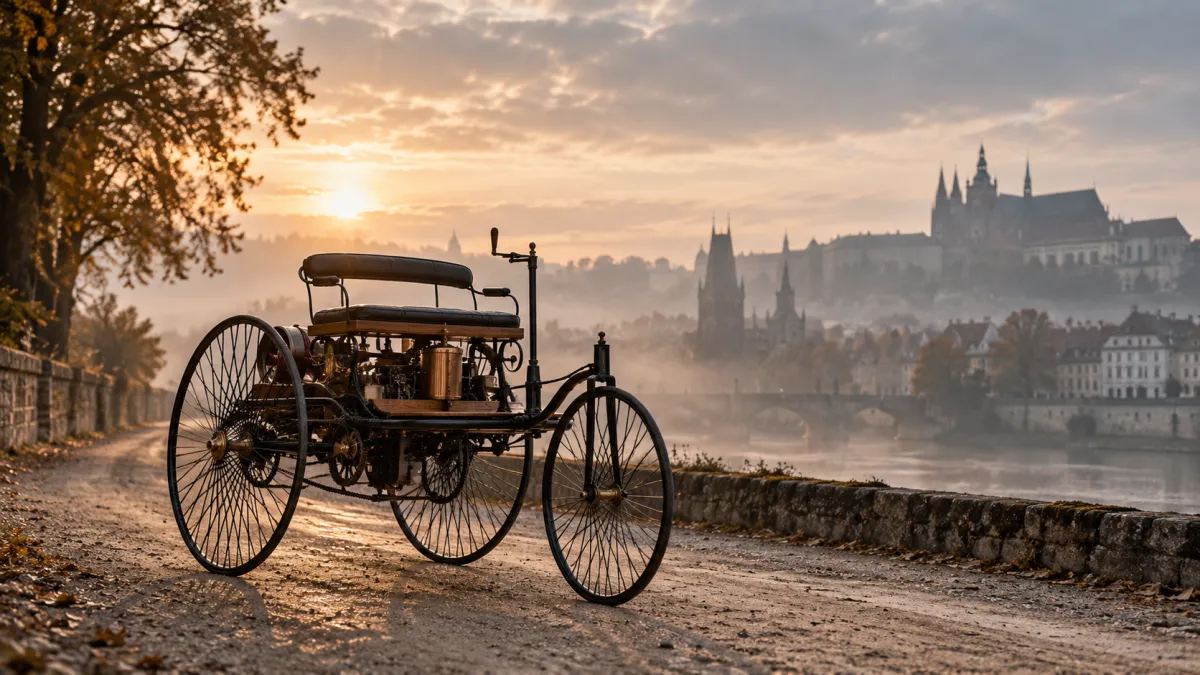
How one strange three-wheeled machine helped create not just the automobile, but an entirely new relationship between people, machines and movement.
Benz Patent-Motorwagen · 1886 Before Ferrari. Before Porsche. Before the Nürburgring. Before racing, road trips, petrol stations, traffic lights and driver’s licences. Before teenagers dreamed about their first car and collectors argued about originality. Before motorsport, tuning, supercars, Sunday drives, automotive photography or posters on bedroom walls. There was this. Three wheels. Two seats. A single cylinder. Less than one horsepower. And an idea that would eventually change almost everything. The Benz Patent-Motorwagen looks almost impossibly primitive today. Its enormous wire wheels and exposed mechanical components make it appear closer to a Victorian scientific instrument than something we would recognize as a car. There is no steering wheel. No windscreen. No roof. No doors. No dashboard. And, importantly, no existing car culture into which it could fit. Because when Carl Benz created his Patent-Motorwagen, the automobile wasn’t yet an object of desire, identity or freedom. The very idea of the automobile was still being invented.
BEFORE THE CAR
To understand the Patent-Motorwagen, we have to imagine a world in which the car does not exist. Not a world with fewer cars. A world with none. The streets of late-19th-century Europe belonged primarily to pedestrians, horses, bicycles, carts and carriages. Railways had already transformed long-distance travel, but personal mobility remained fundamentally different from what we know today. If you wanted independent transportation, the horse was still one of humanity’s most important technologies. That shaped society. A journey required planning around animals, rail schedules and available routes. Towns and cities had evolved around walking distances and horse-drawn transport. The sounds, smells and rhythms of streets were entirely different. Into this world came a machine that required no horse. That fact seems obvious now. In the 1880s, it was radical. The Patent-Motorwagen represented something larger than a new mechanical invention. It suggested that an individual might possess a machine capable of carrying them wherever a road allowed, powered by an engine rather than muscle. The implications were enormous. But first, someone had to convince people that it actually worked.
CARL BENZ AND THE PROBLEM OF INVENTING SOMETHING NOBODY NEEDED YET
Carl Benz wasn’t simply attempting to attach an engine to an existing carriage. That distinction matters. Experiments with steam-powered road vehicles and motorized carriages already existed. Other inventors were working on internal-combustion engines. Gottlieb Daimler and Wilhelm Maybach were developing their own motorized vehicles during the same period. Benz’s approach was different. He wanted to create a vehicle designed from the beginning around its engine. The machine that emerged was therefore not quite a carriage and not quite a bicycle. It was something new. At the rear sat a single-cylinder four-stroke engine. Power reached the rear wheels through belts and chains. The front wheel provided steering. The layout produced one of the Patent-Motorwagen’s most recognizable characteristics: three wheels. Benz understood engines. Steering two front wheels reliably was another engineering challenge entirely. The three-wheel configuration provided a practical solution. On January 29, 1886, Benz filed the patent associated with his motor vehicle. The document would later become one of the most important pieces of paper in automotive history. But receiving a patent is one thing. Creating a culture around an invention is another. And that part of the story belongs just as much to Bertha Benz.
BERTHA
Automotive history has traditionally been written around inventors, engineers, racing drivers and company founders. But one of the first great stories in automotive culture belongs to a woman who understood something crucial: A machine doesn’t become important because it exists. It becomes important when people understand what it can do. Bertha Benz had supported Carl’s work financially and personally. She also recognized that his invention needed something more convincing than demonstrations near the workshop. It needed a journey. In August 1888, without first informing Carl of the plan, Bertha left Mannheim with her sons Eugen and Richard in a later version of the Motorwagen. Their destination was Pforzheim, where Bertha’s mother lived. The distance was roughly 100 kilometres. Today, that’s an ordinary drive. In 1888, it was an expedition into a world that possessed essentially none of the infrastructure required by the automobile. There were no filling stations. No roadside mechanics trained to repair cars. No standardized road signs for motorists. No network built around automotive travel. The journey therefore became something remarkable. Bertha Benz wasn’t merely driving through Germany. She was effectively discovering the problems that an automotive society would eventually have to solve.
THE FIRST ROAD TRIP
This may be where car culture truly begins. Not with the invention itself. With the journey. Bertha and her sons encountered mechanical problems and solved them using what was available. Fuel was another problem. The Motorwagen used ligroin, a petroleum solvent that could be purchased from pharmacies. At Wiesloch, Bertha stopped at a pharmacy to obtain more. That pharmacy is consequently often described as the world’s first filling station. Think about how extraordinary that transformation is. A place selling medicinal and household substances accidentally became part of the birth of an entirely new infrastructure. Today, petrol stations are such familiar pieces of the landscape that they’re almost invisible. But somebody had to be the first person who needed fuel while travelling. Someone had to ask: Where do I get more? Bertha Benz was confronting questions that billions of motorists would later take for granted.
WHEN THE DRIVER BECAME THE MECHANIC
Early motoring demanded something modern drivers rarely experience. Mechanical improvisation. When a fuel line became blocked, Bertha reportedly cleared it using a hatpin. When insulation was required, she used her garter. When the vehicle’s braking system needed attention, a shoemaker was enlisted to attach leather to the brake blocks—an intervention frequently described as an early example of brake lining. Whether viewed as engineering improvisation or roadside ingenuity, these episodes created something that would become deeply embedded in automotive culture: The relationship between driver and machine. For much of the automobile’s history, driving meant understanding at least something about the machinery underneath you. Drivers carried tools. They listened for unfamiliar sounds. They learned how engines behaved. Roadside repairs became part of travel. Entire enthusiast cultures would eventually grow around precisely this relationship. More than a century later, someone adjusting carburetors in a garage or repairing an old Porsche beside the road is participating in a tradition that reaches surprisingly far back. Bertha wasn’t simply one of the first motorists. She was one of the first roadside mechanics.
PEOPLE MUST HAVE THOUGHT IT WAS INSANE
Imagine seeing the Motorwagen in 1888 without knowing what a car was. There is no cultural reference point. No word in your everyday vocabulary that completely explains what you’re seeing. A carriage approaches. There is no horse. Instead, machinery is moving it. It makes unfamiliar noises. It smells unfamiliar. People are sitting on it. And it keeps going. The psychological impact of early automobiles is difficult for modern people to reconstruct because cars have surrounded us from birth. We know what an engine sounds like before we understand what an engine is. Children recognize cars almost immediately. Roads, parking spaces, garages, traffic lights and filling stations are simply part of the architecture of life. The people who watched the Patent-Motorwagen pass had none of those references. They weren’t seeing an old car. They were seeing the future without knowing what the future was.
THE AUTOMOBILE CREATES THE MOTORIST
The Motorwagen did more than introduce a machine. Eventually, machines like it created a new kind of person: the motorist. That identity did not exist before the automobile. Soon there would be people who drove because they had to. Then people who drove because they wanted to. People who cared about speed. People who cared about engineering. People who wanted to race. People who wanted more luxurious automobiles. People who wanted smaller ones. Faster ones. Cheaper ones. More beautiful ones. Eventually people would identify themselves partly through the vehicles they chose. And that’s where the story becomes culture.
FROM TRANSPORTATION TO IDENTITY
Every major automobile culture that followed can trace part of its existence back to the fundamental proposition represented by the Motorwagen: personal mechanical mobility. Consider what came afterward. The automobile created new professions. Mechanics. Chauffeurs. Designers. Racing drivers. Dealers. Petrol-station attendants. Automotive journalists. Engineers specializing in disciplines that hadn’t previously existed. It created industries. Tyres. Fuel. Roads. Parking. Insurance. Dealerships. Repair shops. Motorsport. Car washes. Rental companies. It changed geography. Suburbs became possible on entirely different scales. Road networks expanded. Businesses moved toward highways. Motels and roadside restaurants appeared. And eventually the automobile created cultures that had almost nothing to do with transportation. Hot rodding. Lowriding. Motorsport. Cruising. Tuning. Car collecting. Off-roading. Concours events. Cars and Coffee. Drifting. Supercar culture. JDM. Track days. Road trips. Automotive photography. Even the simple ritual of going for a Sunday drive. None of those things were inherent in the original machine. Culture accumulated around it.
THE ROAD TRIP
Perhaps one of the most profound cultural consequences of the automobile is that it transformed the journey itself. Rail travel follows someone else’s route. The automobile introduced another possibility. Turn left. Turn right. Stop. Continue. Change your mind. Take the longer road. The destination could become secondary. Driving itself could become the activity. Bertha’s journey from Mannheim to Pforzheim wasn’t undertaken for pleasure in the modern sense. It was practical, promotional and experimental. But it unintentionally demonstrated one of the automobile’s greatest cultural promises: independence. That idea would later become central to automotive advertising. Freedom. Escape. The open road. Entire generations would grow up associating obtaining a driver’s licence with adulthood. The first car would become a rite of passage. The road trip would become a genre of literature and cinema. And the automobile would become perhaps the ultimate mechanical symbol of personal freedom. The seed of all of that is visible in Bertha’s journey.
THE FIRST CAR DIDN’T HAVE A CULTURE
This is what makes the Patent-Motorwagen particularly fascinating for Cars & Culture. Every other car in this magazine exists inside an automotive world. The Ferrari F40 arrived into an established supercar culture. The Porsche 911 entered an existing sports-car tradition. The Volkswagen Golf GTI reinterpreted the family hatchback. The Nissan Skyline GT-R became part of tuning, gaming and Japanese performance culture. But the Patent-Motorwagen arrived before any of it. It had no category. There were no enthusiasts waiting for the newest model. No automotive magazines reviewing it. No photographers shooting it for advertisements. No collectors discussing values. No motorsport fans debating lap times. It wasn’t entering car culture. It was helping create the conditions from which car culture could eventually emerge.
FROM 0.75 HORSEPOWER TO 1,000
There is something almost comical about comparing the Patent-Motorwagen with the machines it ultimately preceded. Its early engine produced well under one horsepower. Today, family cars can produce hundreds. Performance cars routinely exceed figures that would have sounded absurd even a few decades ago. Hypercar manufacturers now speak casually about four-digit outputs. But horsepower isn’t really the meaningful comparison. The extraordinary thing isn’t how primitive the Motorwagen was. It’s how recognizable its fundamental promise remains. You control the machine. The machine carries you somewhere. You choose where. That relationship survived every technological revolution that followed. Carburetors became fuel injection. Crank handles became starter motors. Drum brakes became carbon ceramics. Steel became aluminium and carbon fibre. Mechanical gauges became digital screens. Engines are now being replaced by electric motors. But people still walk toward a vehicle carrying the same basic expectation: Take me somewhere.
BEFORE FERRARI, THERE HAD TO BE BENZ
Car enthusiasts naturally celebrate the spectacular chapters. Le Mans. Monaco. The Mille Miglia. Group B. The Nürburgring. Ferrari. Porsche. Lamborghini. BMW M. AMG. Skyline GT-R. The supercar. The hot hatch. The muscle car. The tuner car. But none of those stories can happen until the automobile itself becomes viable. That is why the Patent-Motorwagen deserves to be called an icon even though almost nobody dreamed of owning one as a teenager. Its importance isn’t aspirational. It is foundational. The Ferrari F40 represents one extreme of what the automobile eventually became. The Benz Patent-Motorwagen represents the moment when the possibility began.
AND THEN CAME CULTURE
Perhaps Carl Benz’s greatest invention wasn’t ultimately a three-wheeled vehicle. It was possibility. Once humans discovered they could travel independently using machines, they inevitably began asking for more. More distance. More reliability. More comfort. More speed. Then beauty. Then status. Then excitement. Then individuality. Eventually, automobiles stopped being merely inventions and became expressions of who we were—or who we wanted to be. A farmer’s tool. A family possession. A racing machine. A teenager’s freedom. A celebrity’s status symbol. A designer’s sculpture. A mechanic’s obsession. A collector’s treasure. A driver’s escape. More than a century after the Patent-Motorwagen first appeared, humanity has built hundreds of millions of automobiles. Some are disposable transportation. Some are masterpieces. Some become icons. And around them we created something Carl and Bertha Benz could never have fully predicted:
car culture.
Today we argue about manual transmissions and electric cars. We wake before sunrise to drive roads that lead nowhere important. We spend years restoring machines that would be easier to replace. We photograph cars, race them, modify them, collect them and attach memories to them. We give them names. We miss them when they’re gone. Sometimes we love them despite knowing perfectly well that they’re only machines. All of that came later. But first, someone had to build the car. And someone else had to prove that it could take us somewhere.
THE ICON
Benz Patent-Motorwagen Year: 1886 Creator: Carl Benz Engine: Single-cylinder, four-stroke petrol engine Layout: Rear-mounted engine, rear-wheel drive Wheels: Three Power: Less than 1 hp in its earliest form Cultural significance: Helped establish the automobile as a viable form of independent transportation Defining moment: Bertha Benz’s 1888 Mannheim–Pforzheim journey
WHY IT’S AN ICON
Not because it was fast. Not because it was beautiful. Not because it won races. And certainly not because it appeared on bedroom walls. The Benz Patent-Motorwagen is an icon because almost every automotive story that followed required someone to prove one idea first: that we didn’t need the horse anymore. And once that happened, transportation became something else. Eventually, it became culture.