Issue No. 01 — THE DRIVE ISSUEFeatures · Story 2 of 3
Ford Model T · 1908–1927
ICONS · THE AUTOMOBILE FOR EVERYONETHE CAR THAT PUT THE WORLD ON WHEELS
The Benz Patent-Motorwagen introduced the automobile to the world. The Ford Model T put it into the hands of ordinary people. More than 15 million examples would eventually be built, transforming the way people worked, traveled and experienced freedom. But its greatest legacy wasn’t simply mass production. It was helping turn the automobile from an extraordinary invention into an everyday possession—and laying the foundations for the car culture we know today.
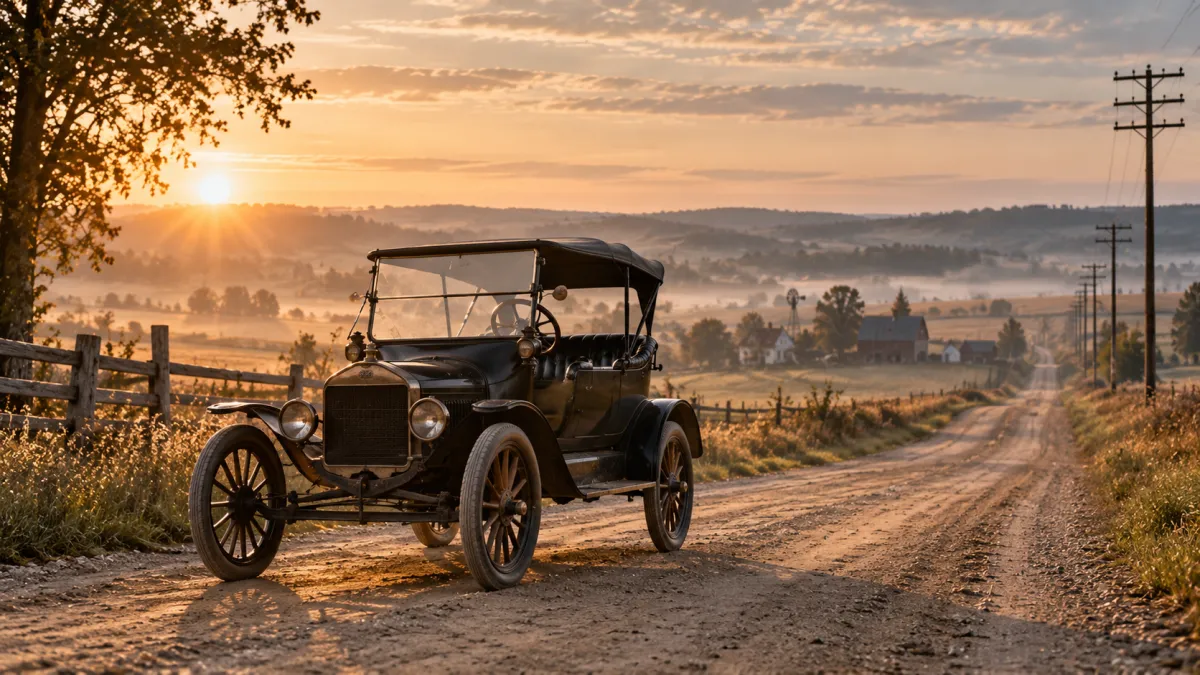
How the Ford Model T transformed the automobile from a machine for the few into a possession for the many—and helped create the world in which car culture could flourish.
Ford Model T · 1908–1927 The automobile had been invented. Now somebody had to make it matter to everyone else. When the Benz Patent-Motorwagen appeared in 1886, it represented an extraordinary new possibility: independent transportation powered by a machine rather than a horse. But invention alone wasn’t enough to transform society. Early automobiles remained expensive, unfamiliar and inaccessible to most people. For the automobile to truly change the world, it couldn’t remain a curiosity for engineers or a luxury for the wealthy. It had to become ordinary. It had to become attainable. It had to become something a farmer, shopkeeper, factory worker or family could imagine owning. And in 1908, a relatively simple black machine from Detroit began pushing the automobile toward exactly that future. Its name was the Ford Model T.
BEFORE THE MODEL T
By the beginning of the 20th century, the automobile was no longer an isolated experiment. Manufacturers were appearing across Europe and America. Engines were improving. Motor races demonstrated what the new machines could do. Wealthy motorists were discovering the excitement of driving. But cars were still largely possessions of privilege. They were expensive to manufacture and expensive to purchase. Production was labor-intensive. Roads were inconsistent. Mechanical reliability varied enormously. The automobile existed. The automotive world we recognize did not. Henry Ford understood that the greatest opportunity wasn’t necessarily building the most luxurious or exotic automobile. It was building one that enormous numbers of people could use. The Model T, introduced in 1908, was designed around that idea. It was relatively simple, durable and adaptable. Its high ground clearance made sense on roads that often deserved the word only generously. Its four-cylinder engine provided sufficient power without unnecessary complexity. Most importantly, Ford intended to manufacture it at a scale the young automobile industry had barely imagined. The revolution wouldn’t happen only under the Model T’s bonnet. It would happen in the factory.
THE MACHINE THAT MADE THE MACHINE
The Model T is often remembered alongside one of the great symbols of industrialization: the moving assembly line. Ford did not invent the concept of an assembly line from nothing, nor did the first Model Ts roll from a moving line in 1908. Manufacturing methods evolved over the following years as Ford and his teams relentlessly searched for ways to simplify production. At Ford’s Highland Park plant, the moving assembly line was introduced into automobile production in 1913. The principle was transformative. Instead of skilled workers building large portions of an automobile in relatively static positions, production could be divided into increasingly specialized tasks while the product moved through the factory. Time fell. Volume increased. Costs could fall with it. The automobile was beginning its transformation from a hand-built mechanical object into a product of mass industrial society. And that changed more than manufacturing. It changed who could participate in motoring.
AFFORDABILITY CHANGES EVERYTHING
The Model T initially sold for $850 in 1908. As Ford’s production became more efficient and volumes increased, its price eventually fell dramatically. That was fundamental to the Model T story. Ford wasn’t merely trying to manufacture more automobiles. He was helping create more automobile owners. The distinction is enormous. Luxury cars could demonstrate engineering excellence. Racing cars could demonstrate speed. But an affordable car could change everyday life. As the Model T became increasingly accessible, the automobile stopped being something ordinary people merely watched pass them on the road. More of them could climb inside. Start the engine. And decide where to go. That shift—from spectator to owner—is one of the foundations of car culture.
WHEN THE CAR ENTERED THE FAMILY
Eventually, the automobile became more than machinery. It became part of the household. That cultural transformation is easy to underestimate. A family’s car could determine where they lived, where they worked, where they shopped and where they spent their free time. It could carry children. Groceries. Tools. Luggage. Produce. Friends. Memories. The Model T was offered in numerous body styles and adapted for countless purposes. People converted them into work vehicles, delivery vehicles and machines suited to agricultural life. The automobile was becoming personal. And once an object becomes personal, people begin changing it. They repair it. Customize it. Improve it. Complain about it. Become attached to it. That relationship between person and machine is where transportation starts turning into culture.
AMERICA GETS BIGGER—AND SMALLER
The United States was geographically enormous. The automobile changed how that geography felt. For rural communities in particular, personal motorized transportation could fundamentally alter the relationship between home and the outside world. Distances that had once required considerable time and effort became more manageable. Towns became easier to reach. Families could travel farther. Businesses could serve larger areas. Doctors, salespeople and tradespeople could move differently. The automobile compressed distance. At the same time, it expanded possibility. A place 20 miles away could become part of ordinary life rather than a significant journey. The map had not changed. But people’s relationship with it had.
THE ROAD BEGINS TO MATTER
There is an irony at the heart of early mass motoring. Cars needed roads. But many roads had never been designed for cars. As automobile ownership expanded, pressure increased for improved road infrastructure. Motoring organizations advocated for better routes. Governments increasingly confronted the reality that the automobile was not disappearing. Roads improved. Networks expanded. Signs appeared. Traffic laws developed. Fuel became easier to obtain. Repair businesses emerged. Garages became architectural necessities. The car began changing the physical world around itself. This is one of the Model T’s greatest cultural legacies. It wasn’t merely adapted to society. Society increasingly adapted itself to the automobile.
THE BIRTH OF THE AUTOMOTIVE ECOSYSTEM
Once millions of cars exist, millions of cars need things. Fuel. Oil. Tyres. Replacement parts. Repairs. Roads. Insurance. Parking. Dealerships. Maps. Hotels. Restaurants. The automobile created an ecosystem. Entire professions and industries grew alongside it. Mechanics became essential. Petrol stations became familiar landmarks. Roadside businesses discovered that motorists were customers passing directly by their doors. Eventually there would be motels, drive-in restaurants, roadside attractions and entire commercial landscapes designed around the person arriving by automobile. The Model T didn’t create every one of these things by itself. But mass automobile ownership provided the conditions that allowed them to flourish. Car culture requires cars. Lots of them.
THE CAR AS FREEDOM
Automotive advertising would eventually spend billions selling one idea above almost every other: Freedom. The empty road. The distant horizon. The ability to leave. That association wasn’t invented entirely by advertising. The automobile genuinely changed the individual’s ability to move independently. A railway could take you great distances, but it decided where the tracks went. A timetable decided when the train left. The automobile offered something fundamentally different. You chose the destination. You chose the departure time. You could stop. Turn around. Take another road. Or simply keep going. That freedom would become one of the most powerful emotional ideas attached to the automobile. And once driving becomes emotional rather than purely functional, car culture isn’t far behind.
THE ROAD TRIP BECOMES POSSIBLE
Bertha Benz had demonstrated the potential of the long-distance automobile journey decades earlier. Mass ownership transformed the idea. Travel by automobile gradually became something ordinary families could contemplate. The journey itself began acquiring meaning. People could pack luggage into a car and discover places between railway stations. They could explore landscapes at their own pace. The automobile introduced spontaneity into travel. And with that came one of the great rituals of automotive culture: the road trip. Eventually, roads themselves would become destinations. Route 66. The Pacific Coast Highway. The Alpine passes. The Autobahn. The Route Napoléon. But before roads could become romantic, automobiles had to become common enough for people to experience them personally. The Model T helped create that audience.
LEARNING THE MACHINE
Model T ownership also demanded something from its drivers. Participation. Early automobiles were mechanical objects in a much more visible sense than today’s cars. Owners often understood how their machines functioned because circumstances required them to. Maintenance and roadside repair were part of motoring. Ford’s enormous production numbers also encouraged an extensive ecosystem of parts, accessories and knowledge. People learned their cars. And then, inevitably, some began modifying them. A machine designed for mass production became a platform for individual creativity. That contradiction remains at the center of car culture today. Manufacturers produce cars by the thousands or millions. Owners immediately look for ways to make theirs different. Different wheels. Different suspension. More power. Different paint. Different purpose. The desire to personalize the automobile is almost as old as mass automobile ownership itself.
FROM MODEL T TO HOT ROD
As Model Ts aged and became inexpensive used cars, they found another life. Young enthusiasts and mechanically adventurous owners discovered that Ford’s simple, abundant machines could be altered. Bodies could be removed. Weight reduced. Engines modified or replaced. Cars lowered. Cars raced. What had begun as practical transportation became raw material. This matters enormously to the cultural history of the automobile. The hot rod didn’t emerge fully formed from a factory. It grew from people looking at existing cars and asking: What if we changed it? The Model T and later early Fords became part of the foundation upon which American hot-rodding culture developed. Suddenly the automobile wasn’t simply something manufacturers created. It was something owners could reinterpret. That idea would echo through virtually every modification culture that followed. Custom cars. Lowriders. Drag racing. Street machines. European tuning. Japanese tuning. Drifting. Restomods. The details changed. The instinct did not. Make the car yours.
ONE CAR, A THOUSAND PURPOSES
Perhaps the Model T’s greatest strength was that it didn’t belong to one type of person. It could be family transportation. A farmer’s tool. A delivery vehicle. A doctor’s transportation. A traveling salesman’s office. A young person’s mechanical project. A racer’s starting point. That versatility gave it cultural reach. The most influential automobiles aren’t always those that perform one task perfectly. Sometimes they are the cars that allow enormous numbers of people to discover what the automobile can mean to them. The Model T did exactly that.
ANY COLOR SO LONG AS IT’S BLACK
Few quotations in automotive history are as closely associated with a car as Henry Ford’s famous line about customers being able to have a Model T in any color “so long as it is black.” The reality is more complicated. Early Model Ts were available in multiple colors. During the years of Ford’s enormous production expansion, black became the dominant—and for a period effectively standardized—finish. Later Model Ts again appeared in other colors. But the line survived because it represents something larger. The Model T was not primarily about bespoke individuality at the factory. It was about efficiency. Standardization. Scale. That created an interesting cultural paradox. Ford standardized the automobile so ordinary people could afford one. Then ordinary people began personalizing those standardized automobiles. Mass production helped create customization. Sameness created a desire for difference. Car culture has been living inside that contradiction ever since.
THE FACTORY CHANGES CULTURE TOO
The Model T’s cultural story isn’t only about the people who drove it. It is also about the people who built it. Mass production transformed industrial labor. Factory work became increasingly specialized and repetitive as manufacturing was divided into smaller operations. Ford’s famous $5 workday, introduced in 1914 for qualifying workers under particular conditions, became part of the company’s mythology and attracted enormous attention. The automobile was therefore reshaping culture at both ends of the production line. It changed the lives of consumers. And it changed industrial work itself. Detroit would become inseparable from the automobile. Factories drew workers from across America and from abroad. Neighborhoods developed around industrial employment. Fortunes were created. So were tensions. The car was no longer simply an invention. It had become an economic force.
DETROIT BECOMES MOTOR CITY
Certain cities eventually become inseparable from particular industries. Detroit became inseparable from the automobile. Ford was only part of that transformation, but an enormous one. The scale of American automobile manufacturing helped turn Detroit into a symbol of industrial power. Cars shaped its economy, architecture, demographics and identity. Eventually they would influence its music and popular culture too. Decades later, “Motor City” would mean more than factories. It would evoke American manufacturing, muscle cars, cruising, Motown, Woodward Avenue and the complicated relationship between a city and the industry that helped build it. That is culture. And the Model T sits near the beginning of that story.
WHEN EVERYONE CAN DRIVE, EVERYONE CAN DREAM
The Model T was not a sports car. It wasn’t glamorous. It wasn’t designed to make its owner look sophisticated outside a fashionable hotel. But democratizing the automobile created something necessary for every enthusiast culture that came afterward: an audience. Once millions of people experience cars, some inevitably begin wanting something different. Faster. More comfortable. More luxurious. More beautiful. More capable. More individual. Some begin racing. Others begin modifying. Others simply begin caring. The automobile becomes a subject of conversation. People compare machines. Develop preferences. Choose brands. Argue about engineering. Admire styling. A consumer becomes an enthusiast. And an industry becomes a culture.
FROM TRANSPORTATION TO PERSONALITY
This transformation is fundamental to Cars & Culture. Cars begin as tools. Then humans do what humans always do with tools that become part of everyday life: We attach meaning to them. A car can say something about income. Occupation. Taste. Age. Ambition. Rebellion. Practicality. Status. Belonging. Eventually entire identities emerge around them. Ford person. Chevrolet person. Porsche person. BMW person. Jeep person. Hot-rodder. Lowrider. Racer. Collector. Tuner. The Model T predates most of those identities. But mass ownership helped create the social environment in which they could develop.
THE NUMBER THAT EXPLAINS EVERYTHING
More than 15 million Model Ts were produced before production ended in 1927. That number matters because scale was the point. The Benz Patent-Motorwagen demonstrated that the automobile could exist. The Model T demonstrated that the automobile could become normal. And normality changed everything. Once automobiles were everywhere, society could no longer treat them as novelties. Cities had to accommodate them. Governments had to regulate them. Businesses had to serve them. Families organized their lives around them. Young people dreamed about owning them. The automobile became embedded in modern life.
THE WORLD AFTER THE MODEL T
By the time Model T production ended, the world of the automobile looked fundamentally different from the one into which it had arrived. Cars were becoming increasingly sophisticated. Competition between manufacturers was intensifying. Customers wanted more than basic transportation. Styling mattered. Comfort mattered. Power mattered. Prestige mattered. And increasingly, personality mattered. The automobile had entered its next phase. The Model T had helped prove that the world wanted cars. Now manufacturers could begin asking what kind of cars people wanted. That question would eventually give us almost everything enthusiasts celebrate today. Sports cars. Luxury cars. Racing cars. Hot hatches. Muscle cars. Supercars. Off-roaders. Grand tourers. And thousands of machines that served no completely rational purpose beyond making their owners happy.
FROM ONE BLACK FORD TO CAR CULTURE
There is a temptation to view the Model T simply as an artifact of industrial history. That misses the more interesting story. The Model T helped change the automobile’s audience. The car moved away from being primarily an invention encountered by the public and toward becoming an object owned by the public. Ownership changes the relationship. You don’t merely observe the machine. You live with it. You maintain it. You travel in it. You remember where it took you. Perhaps you modify it. Perhaps you teach your children to drive in it. Perhaps years later you remember it as the family car. Those experiences transform mechanical objects into cultural ones. The Model T wasn’t simply transportation for millions of people. It helped teach society what having a car could mean.
AFTER INVENTION CAME ACCESS
Carl Benz helped create the automobile. Bertha Benz demonstrated its possibilities. Henry Ford and the people building Model Ts helped bring those possibilities to a vastly larger audience. That distinction connects the first two chapters of this magazine. The Patent-Motorwagen represents the moment humanity discovered: We can build this. The Model T represents the moment society realized: We can have this. And once people could have cars, they began doing what people do. Driving them. Working with them. Breaking them. Fixing them. Traveling in them. Racing them. Modifying them. Remembering them. Loving them. The automobile had escaped the inventor’s workshop. It had entered everyday life. And somewhere along the way, transportation started becoming culture.
THE ICON
Ford Model T Production: 1908–1927 Manufacturer: Ford Motor Company Engine: 2.9-liter inline-four Power: Approximately 20 hp Layout: Front-engine, rear-wheel drive Production: More than 15 million Defining idea: Making automobile ownership accessible on an unprecedented scale Cultural significance: Helped establish mass motoring and the social, industrial and physical infrastructure surrounding the automobile WHY IT’S AN ICON Not because it was the first car. It wasn’t. Not because it was the fastest. It certainly wasn’t. Not because it was exclusive. Its entire purpose was almost the opposite. The Model T is an icon because it helped take one of the most transformative inventions of the modern age and put it into ordinary people’s hands. The automobile had already been born. The Model T gave it a mass audience. And without that audience, there could never have been car culture.